The Real Cost of Missed Calls for Service Businesses in 2026

If you run an HVAC, plumbing, electrical, or roofing company, here is an uncomfortable truth: your phone is ringing, and you are not answering it nearly as often as you think. The calls you miss are not just inconveniences. They are lost jobs, lost revenue, and customers who end up calling your competitor instead.
This is not guesswork. There is real, verified data on how many calls service businesses miss, what happens when those calls go to voicemail, and how much money disappears as a result. This post walks through all of it with numbers you can actually check.
How Many Calls Are Service Businesses Actually Missing?
The short answer: more than you would expect.
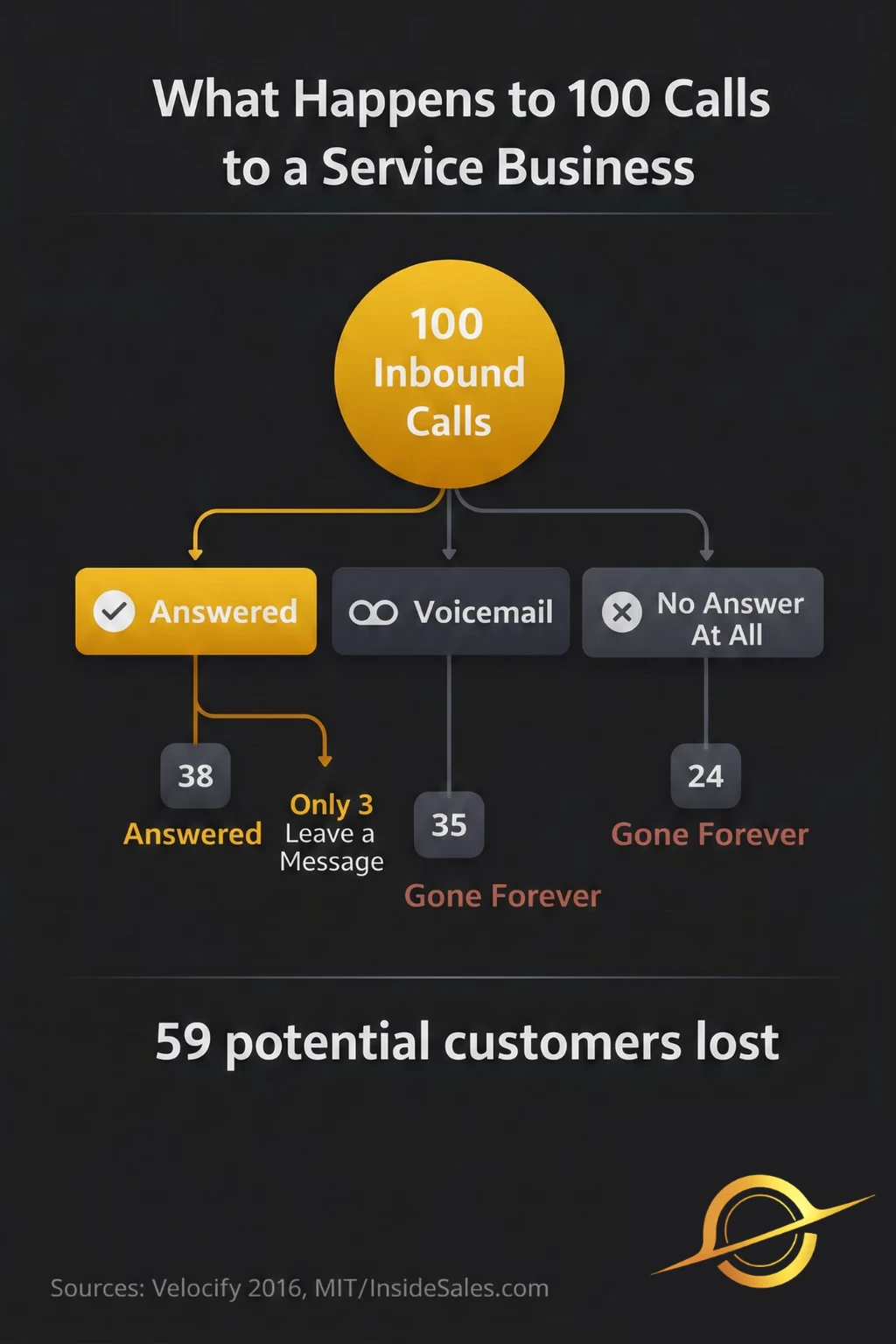
Invoca, a call tracking and analytics platform, analyzed over 60 million phone calls across nine industries and found that 27% of calls to home services businesses go unanswered. That is more than one in four calls from potential customers that never reach a human being.
A separate study by 411 Locals monitored calls to 85 businesses across 58 industries and found the numbers are even worse for small businesses overall. Only 37.8% of calls were answered. Another 37.8% went to voicemail, and 24.3% received no response at all.
That means for the average small business, roughly six out of every ten calls go unanswered.
What Happens When a Call Goes to Voicemail?
This is where the problem gets worse. You might assume that if a caller reaches your voicemail, they will leave a message and you can call them back. That is not what happens.
Invoca's platform data shows that less than 3% of callers who are sent to voicemail at a home services business actually leave a message. CRM Magazine reported similar findings, citing data showing that 80% of callers sent to voicemail do not leave messages because they do not believe anyone will listen. CBS News covered the same trend, noting that voicemail as a business communication tool is effectively dead for most consumers.
Think about that. If your business misses 27 calls in a month and only 3% leave a voicemail, you are getting maybe one message. The other 26 callers are gone. They are already dialing the next company on Google.
The Speed Problem: Why Every Minute Matters
Even when you do pick up the phone or return a call, how fast you respond makes an enormous difference.
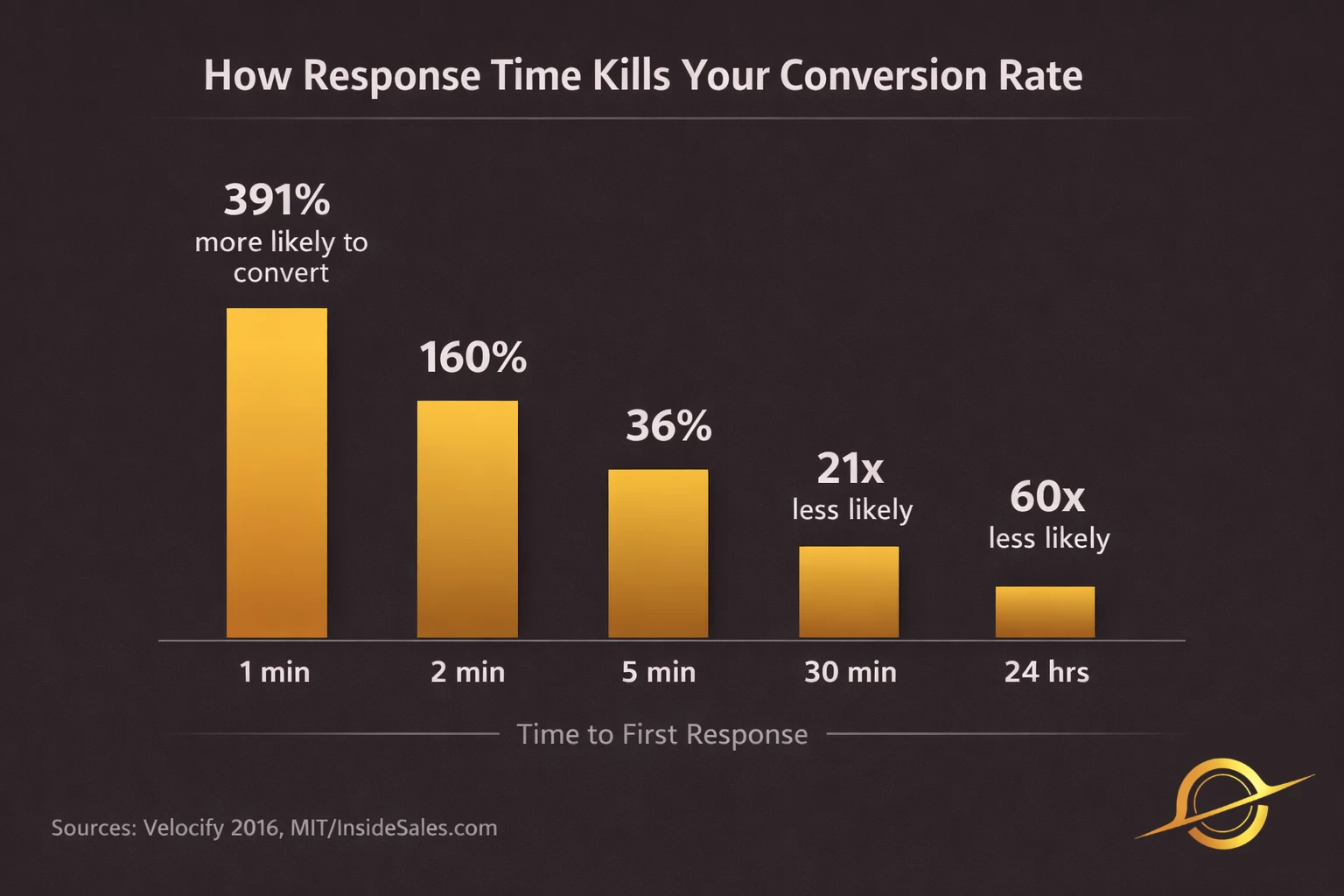
The foundational research on this comes from a study by Dr. James Oldroyd at MIT and David Elkington at InsideSales.com, published in Harvard Business Review. They analyzed 15,000 leads and 100,000 call attempts and found that businesses responding within five minutes were 21 times more likely to qualify a lead than those responding at 30 minutes, and 100 times more likely than those waiting a full day.
A 2021 follow-up study by InsideSales.com expanded the data set to 55 million sales activities across 5.7 million leads at 400 companies. They found that conversion rates are 8 times higher when a lead is contacted in the first five minutes. Despite this, only 0.1% of leads were actually engaged within that window, and 57.1% of first contact attempts happened more than a week after the lead came in.
Velocify's research, published via PR Newswire and based on millions of lead records, quantified the drop-off even more precisely. Prospects who received a call within one minute were 391% more likely to convert. At two minutes, the advantage drops to 160%. At five minutes, it is down to 36%.
Every minute you wait, you lose ground.
What Customers Actually Expect
The research on response time is not just about sales tactics. It reflects what customers genuinely expect when they reach out to a business.
Salesforce's State of the Connected Customer report, based on a survey of 14,300 consumers and business buyers across 25 countries, found that 77% of customers expect to interact with someone immediately when they contact a company. On top of that, 80% said the experience a company provides is as important as its products and services.
A Nextiva survey of 400 U.S. adults found that 76% expect a response in five minutes or less. When they do not get it, 56% immediately try another company and 28% abandon the brand entirely after just one bad experience.
TransUnion's 2024 consumer survey confirmed that nearly 80% of consumers still consider phone calls important for communicating with businesses. The phone is not dead. But your customers will not wait around if no one picks up.
Putting a Real Dollar Amount on Missed Calls
You have probably seen blog posts claiming that small businesses lose $126,000 a year to missed calls. That number gets repeated constantly, but it cannot be traced to any credible original study. It appears to be back-of-the-envelope math recycled between marketing blogs without a real source behind it.
Here is a more honest approach. Let us build the calculation using verified data that you can check yourself.
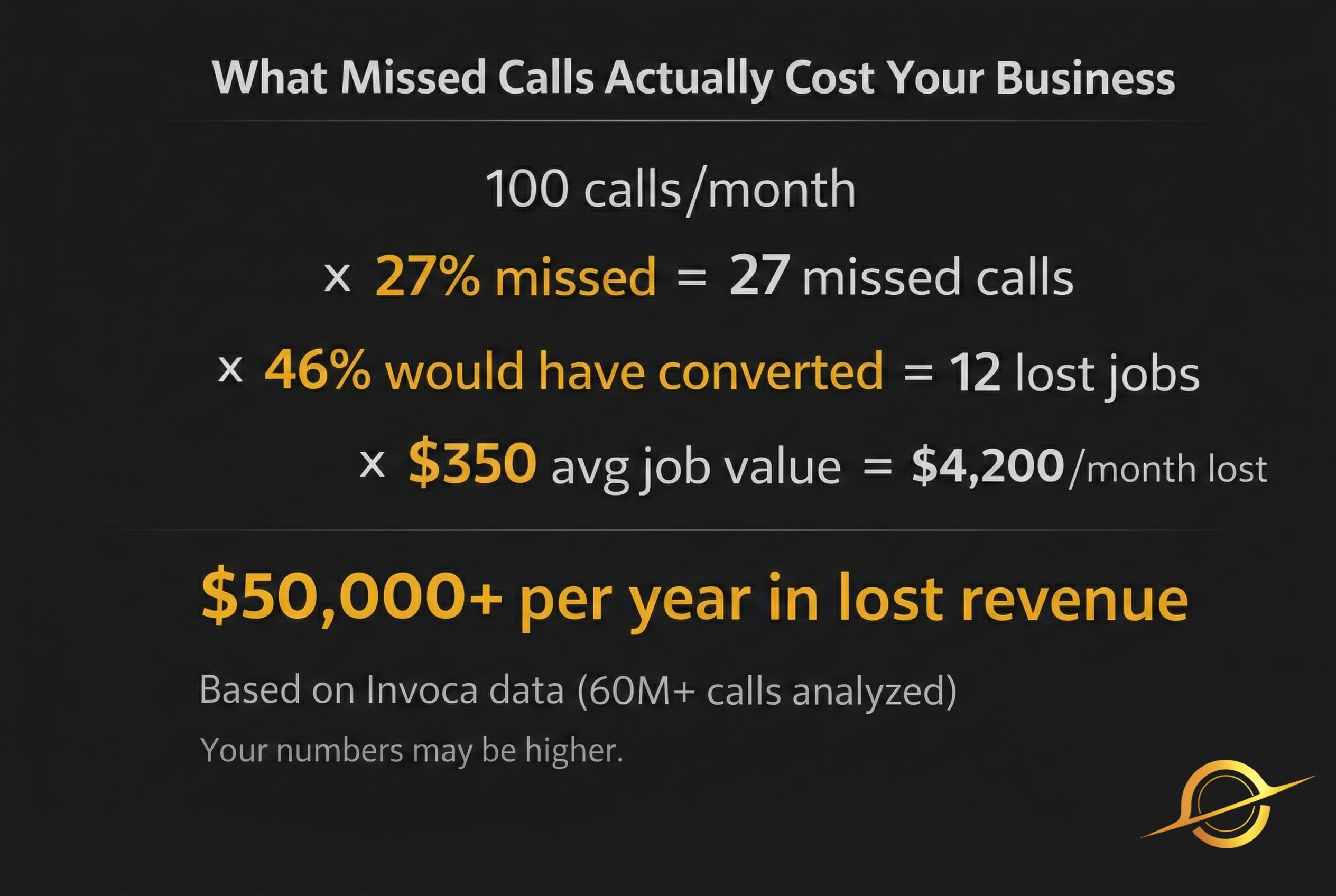
Invoca's analysis of 60 million calls shows that home services businesses miss 27% of inbound calls and that phone leads convert at a 46% rate, the highest of any industry they measured. CallSource, analyzing nearly 20 million calls to home services companies, found similar conversion rates with 56% of inbound calls being viable leads and a 63% call-to-appointment rate for prospect calls.
Now apply that to a realistic scenario. A plumbing or HVAC company that receives 100 calls per month and misses 27% has 27 missed calls. At a 46% conversion rate, that is roughly 12 jobs that would have booked. At an average service call value of $350, that is $4,200 in lost revenue every single month. Over a year, that is more than $50,000.
And $350 is conservative. Housecall Pro's pricing data shows HVAC repairs averaging $400 to $800 and full installations running $5,000 to $10,000 or more. For a company doing higher-value work, the losses climb fast.
Why This Hits Canadian Contractors Especially Hard
Canada has over 100,000 specialty trade contractor businesses, according to Innovation, Science and Economic Development Canada. The vast majority are small operations. Among plumbing, heating, and air conditioning contractors alone, 78% are profitable with average revenues around $705,000.
But here is the gap. The Canadian Federation of Independent Business found that while 92% of Canadian small businesses use some form of digital tools, only 10% have fully integrated them across their operations. Most are still running on manual processes, sticky notes, and hoping someone is near the phone when it rings.
The CFIB research also found that businesses that do invest in technology see a 29% productivity boost in the first year and $1.60 back for every $1 invested. Businesses they classify as "Digital Leaders" who fully integrate their tools see $2.40 back per dollar.
For a trades business losing $50,000 a year to missed calls, the cost of not having a system in place is not theoretical. It is measurable.
The After-Hours Problem
A significant portion of calls come in outside regular business hours. Ruby Receptionists' 2023 Call Trends Report, based on 62.2 million calls, found that shoulder-hour calls between 4 and 6 AM and 5 and 7 PM increased 10% from 2020 to 2022. Calls are arriving as early as 4 AM and as late as 7 PM across most industries.
When a homeowner's furnace breaks at 6 PM on a Tuesday or their basement floods at 5 AM on a Saturday, they are calling whoever shows up first on Google. If your phone goes to voicemail, they are not leaving a message. They are calling the next company. And according to the research we covered above, the first business that answers is overwhelmingly likely to get the job.
This is the part of the missed call problem that no amount of office staff can solve. You cannot have someone sitting by the phone at 5 AM. But the calls still come in, and each one represents a real job at a real dollar value.
What This Looks Like When You Fix It
The solution is not complicated. It is about making sure every call gets answered, every time, regardless of when it comes in.
An AI receptionist can answer your phone line around the clock. It understands what the caller needs, answers questions about your services, and books appointments directly into your scheduling system. It does not put people on hold. It does not send them to voicemail. It handles the call the moment it rings.
The math comparison makes the decision straightforward.
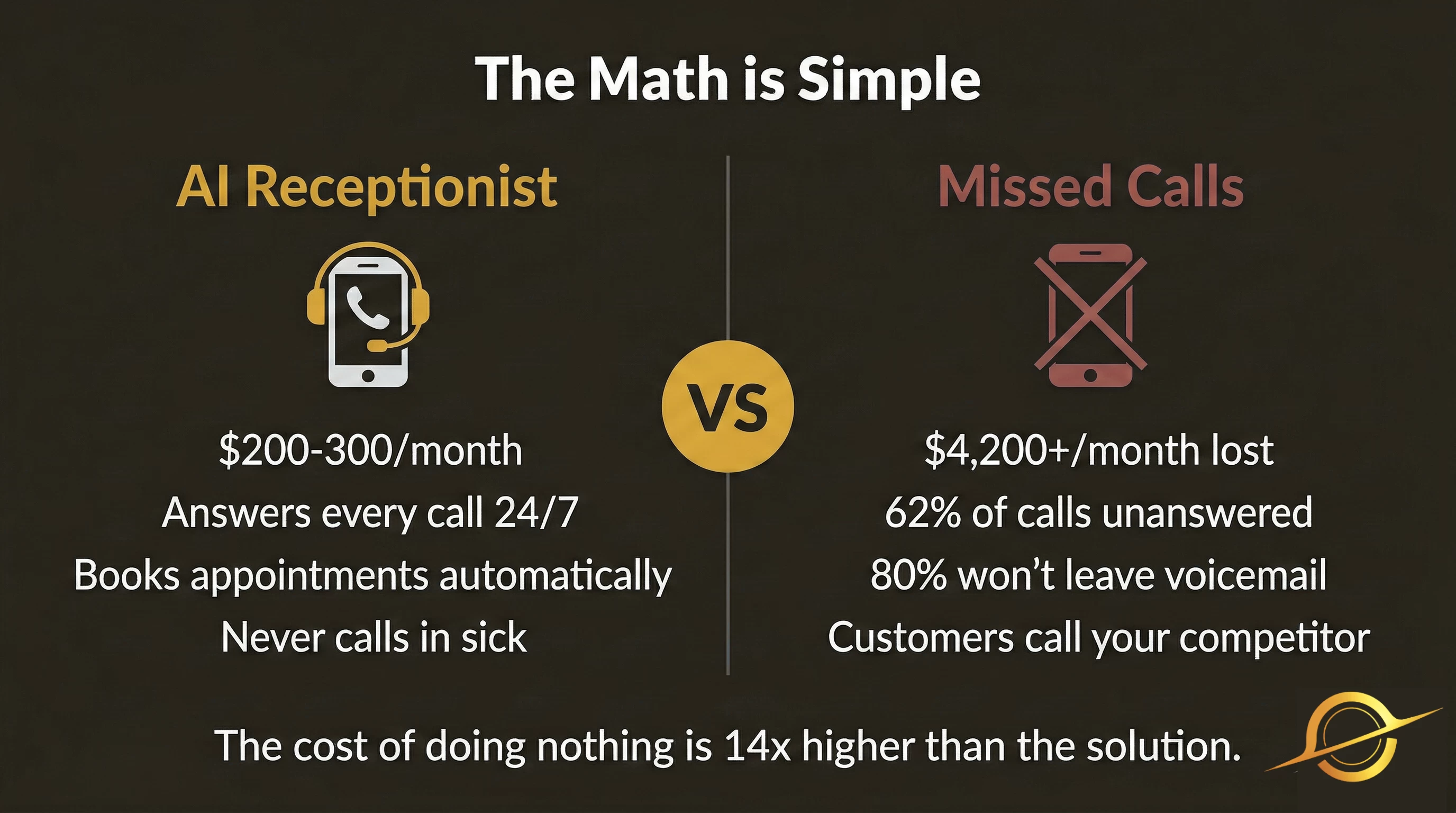
An AI receptionist costs $200 to $300 per month. The missed calls it prevents were costing you $4,200 or more per month. That is a 14x return before you factor in the lifetime value of the customers you keep. If you want to see what AI automation actually costs for a Canadian service business, we put together a full pricing breakdown.
And it pairs with automated follow-up systems that send confirmation texts, trigger review requests after completed jobs, and make sure no lead slips through the cracks. If you are already collecting Google reviews through an automated process, adding call handling to the system means your entire customer intake runs without manual effort.
What You Should Do Right Now
Start by finding out where you actually stand. Check your phone system or call logs for the past 30 days. How many calls came in? How many were answered? How many went to voicemail? If you do not have call tracking, that is the first thing to set up.
Then do the math using your own numbers. Take your missed calls, multiply by your conversion rate (use 46% if you are not sure), and multiply by your average job value. The number will probably surprise you.
If you want help putting a system in place that makes sure you never miss another call, that is exactly what we build at Eventara. We set up AI receptionists, automated follow-ups, and complete intake systems for trades businesses across Alberta. Book a free consultation with our team and we will show you what the numbers look like for your business.
Keep Reading
Related articles
Ready to put these ideas to work for your business?
Get in Touch